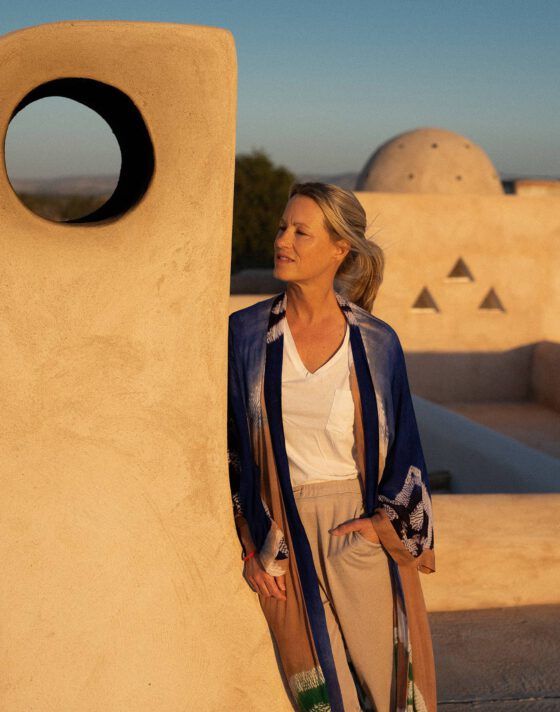
About a decade ago, Anne Petersen played a key role in launching SALON, a glossy magazine devoted to exquisite interiors, travel, culture and food. When the German publishing house Gruner + Jahr decided to discontinue it, Anne and her husband took it over, and they have been publishing it independently since July 2023. Their small company works out of a charming old marzipan factory in Hamburg-Altona, where they meticulously produce four stunning issues a year.
Here at Pretty Hôtels, we admire their work and often notice parallels with the hotels we feature: places that value tradition and would rather serve dinner in a cozy parlor than in a generic hotel restaurant. So we sat down with Anne for a long chat.
Why do you believe a printed magazine can still be successful, even though major publishers are increasingly moving away from it and shifting to digital?
When the magazine portfolio of the Hamburg-based publishing house Gruner + Jahr was set to be streamlined, it quickly became clear to me that I wanted to continue SALON. I had built the magazine with so much passion, and we all produce it with immense dedication and conviction. SALON is a small, handcrafted publication. Every story we create speaks to the mind, the heart, and the soul. It’s also about atmosphere, about capturing the essence of things. Our readers like to immerse themselves in a magazine like ours, with plenty of time and calm. The digital content we consume is far too fast for stories like ours.
By the way, our target audience spends so much of their workday in front of screens. In their free time, they actively seek to reduce the hours spent on digital devices. A printed magazine offers the perfect opportunity to disconnect and focus on something truly meaningful.
Absolutely. Let’s go back in time a bit. Your career started in fashion journalism…
Yes, I moved to Munich to study and also attended the Deutsche Journalistenschule there. I studied art history, politics and communication science and completed my degree at the Sorbonne in Paris. My thesis was on “Fashion Journalism in Germany and France.” That led to my first job, in the style section of the newspaper Welt am Sonntag. After that, I moved to Hamburg to join Brigitte, a women’s magazine, where I spent ten years as a fashion editor, eventually becoming head of the fashion department.
And then the story at SALON began?
When I was pregnant with my fourth child, I naturally wondered how I was going to let the team at Brigitte know that I wasn’t planning to completely step away. I think the publisher already had an idea that I was pretty tough (laughs). After my daughter was born, still during my parental leave, I was offered the opportunity to launch SALON within the same publishing house, Gruner + Jahr. (Side note: SALON was published by the same company as Brigitte.)
What was your main idea for the magazine?
At the time, beauty was already everywhere on the internet. Digitalization was in full swing, with Pinterest and Instagram offering an endless stream of inspiration, things you once found only in magazines. Yet, magazine shelves were still crowded. SALON is, in that sense, a post-digital product. As someone who is very visually driven and reacts strongly to aesthetics, I wanted to create a magazine that personally gave me butterflies. In this way, SALON is somewhat old-fashioned, but it’s also modern because it includes elements that many other magazines have lost over time.


What would be a typical SALON story?
What’s missing is freedom, individuality, kitsch, and romance. People are interested in people, so we portray a lot of individuals who serve as vehicles for the stories we tell. For example, in the column “Traveling with…”, we feature outstanding chefs. The chef is already an exciting story, but the places they love to visit add another layer. And if they happen to be very good-looking, they couldn’t be more perfect for SALON.
You have four children. What do you look for in a hotel when traveling as a family?
It’s fantastic when kids can move around, for example, when there’s plenty of nature to explore or a great pool. For many years, we regularly rented large vacation homes in Umbria with other families. You still need to keep an eye on young children, but once everyone can swim, it’s wonderful and much more relaxing for the adults.
If you’re staying in a hotel with children and the adults want to enjoy it, too, I’d recommend the Bachmair Weissach at Lake Tegernsee. But we also love smaller hotels, like the Albergo Rocciamelone in Italy. At the end of the village road, the façade of this hotel suddenly appears, almost like a Wes Anderson film set. It’s completely preserved in its original Art Nouveau style. The rooms are simple but lovely, with solid wood furniture. The bathrooms are a bit dated, but it’s incredibly affordable, almost like a hostel. It’s so remote that the kids can roam freely. Ours spent days happily building a dam in a mountain stream.
You grew up in northern Germany, near the Danish border. Do you have a favorite hotel up there?
I love the Hornbækhus in the Danish seaside town of Hornbæk, near Copenhagen, especially its sister property Villa Strand. It’s one of those old wooden seaside hotels where you feel like you’re staying with friends. Guests eat together in the evenings, and sometimes there’s even singing. You walk in and find yourself right in the kitchen. Villa Strand is a separate building right by the dunes, with family rooms. It’s a white house with paned windows and a thatched roof – absolutely charming.
Do you prefer family-run hotels?
Yes, they often have a more personal touch, and that’s exactly what we value at SALON. We primarily feature unique hotels that offer a special experience.
In your spring issue, you always present the 50 most beautiful new hotels. What are the selection criteria?
The hotels must fit the idea of SALON and be true discoveries. Similar to Pretty Hôtels, these are places you’d enthusiastically recommend to your closest friends. We aim for a good mix and also include affordable options, such as the Austrian ski hotel Madrisa, where doubles started at around 120 euros when we featured it. Of course, we also feature more expensive hotels, but they must have a story to tell, like the Marbella Club. Many of the hotels we recommend have a special magic: They let you feel like part of a long tradition of travelers.
Do you have an absolute favorite hotel?
There are so many! (laughs) The Svinkløv Badehotel in Denmark is one of my absolute favorites. It’s one of the country’s most traditional seaside hotels, very simple yet beautiful. It’s so popular that it’s hard to get a room. What I love is how it reduces life to the essentials. It’s all about being present in the moment, which is something we’re all seeking right now. The rooms are basic, without TVs, but the food is excellent. And every morning, you can jump into the North Sea.
What about restaurants? Cuisine plays an important role in SALON.
I like the Grill at the Hotel Vier Jahreszeiten in Hamburg. It’s a classic. It’s a great spot for lunch, and my favorite dish is the smoked eel with herb scrambled eggs. For current tips in Hamburg, I personally follow two well-informed Instagram accounts: Franziska Heinemann-Schulte (@tastehamburg) and Julian Ruffner.
How important is interior design to you?
Very important. It’s often a dealbreaker for me. I dislike “instant décor” with knock-off designer furniture that lacks quality and feels dated after just a few years. Such spaces feel sterile and inauthentic. I prefer older hotels with furniture that has grown with the place, even if it’s a bit worn. I have no problem with that; it adds character and warmth to the space.
The subtitle of SALON is “Magazine for Hospitality.” What makes a good host?
Good hosting means giving the guest your attention, making them feel welcome, and ensuring they’re at ease. It’s about approaching the guest openly without being intrusive. Our columnist Denis Scheck wrote an excellent piece on restaurant service for the spring 2025 issue. In it, he cites the motto of the Ritz-Carlton hotel chain: “We are Ladies and Gentlemen serving Ladies and Gentlemen.” It’s all about meeting on equal footing.
Where are you heading on your next trip?
To the Hotel Regina in Mürren. It’s a historic hotel in Switzerland that was saved by its loyal guests. We’ve previously featured it in SALON. Mürren is a wonderful little ski resort in Switzerland, and I’m very much looking forward to it.
Thank you, dear Anne.
P.S. SALON has also published a South Tyrol special edition, a whole issue devoted to one of Italy’s most beautiful regions. It’s packed with fascinating people, the best hotels (including, of course, many Pretty Hôtels members) and especially great restaurants. You can order it at www.salon-magazin.de.
© Pretty Hôtels